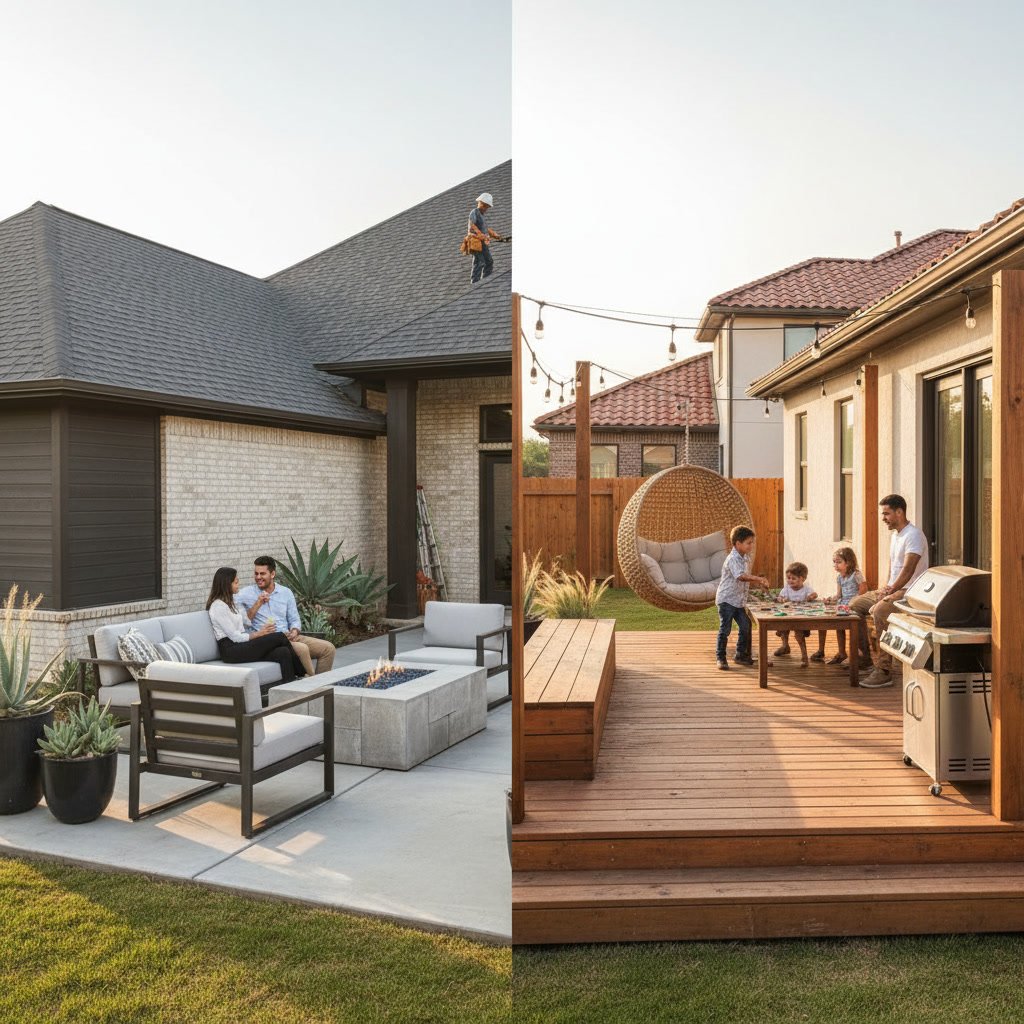
Plano homeowners face a tough choice when adding outdoor living space: should you build a concrete patio or a wood deck? Both options have distinct advantages in North Texas weather, and your decision affects your budget, maintenance schedule, and property value for years to come.
The concrete patio vs deck debate comes down to five key factors: upfront cost, long-term maintenance, durability in Texas heat, design flexibility, and resale value. This guide breaks down each consideration so you can make the right choice for your home and lifestyle.
Upfront Cost Comparison
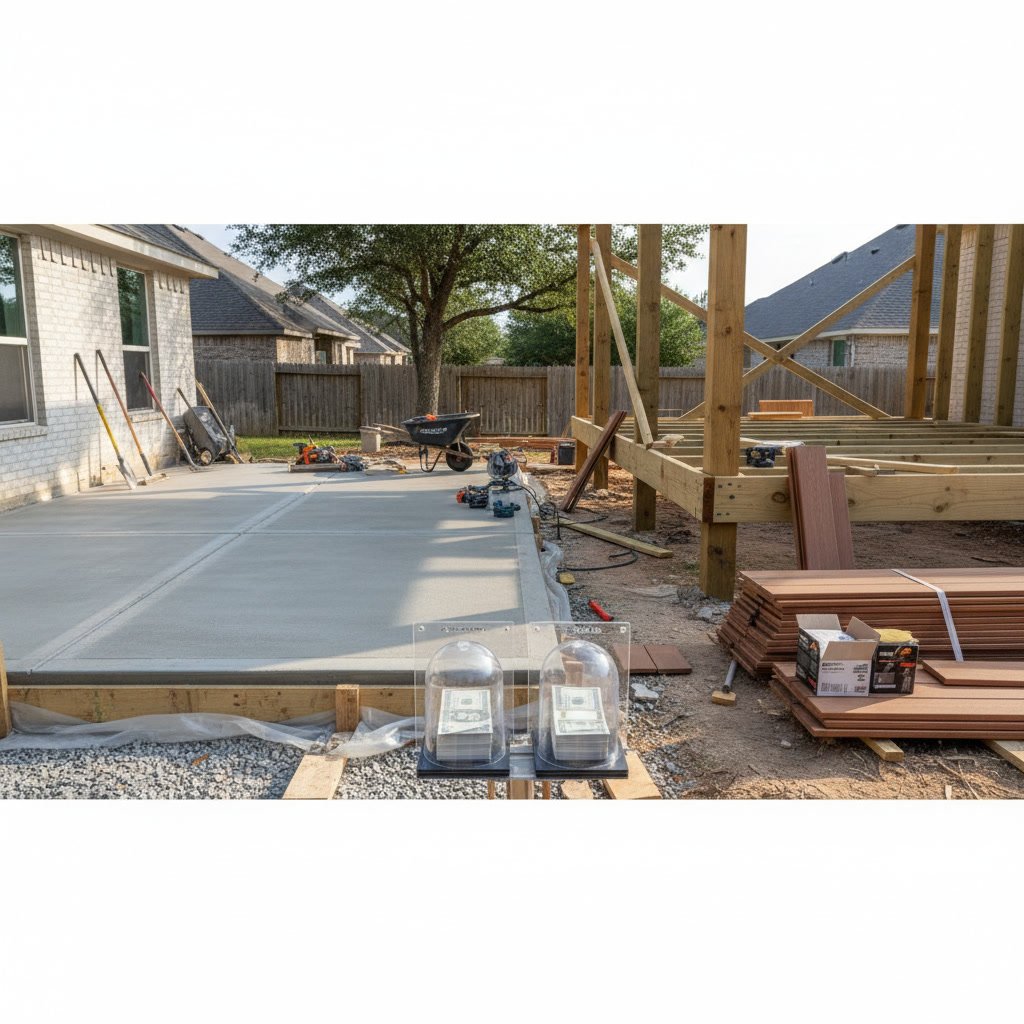
Budget is usually the first question homeowners ask, and there’s a clear winner for lower initial investment.
A basic concrete patio in Plano typically costs between $6 and $12 per square foot for a standard broom-finish installation. That means a 300-square-foot patio runs $1,800 to $3,600. Add decorative elements like stamping, coloring, or exposed aggregate, and you’re looking at $12 to $18 per square foot.
Wood decks start higher. Pressure-treated pine decking costs $15 to $25 per square foot installed, while composite materials run $30 to $45 per square foot. That same 300-square-foot space costs $4,500 to $7,500 for basic wood or $9,000 to $13,500 for composite.
The price gap narrows when you add railings, stairs, or multi-level designs to decks. Concrete rarely needs railings unless elevated, while decks often require them by code when more than 30 inches above grade.
Pro Tip: Site preparation affects both options. Sloped yards may need extensive grading for concrete or additional support posts for decks, adding $1,000 to $3,000 to either project.
Maintenance Requirements Over Time
Initial cost tells only half the story. Maintenance expenses over 10 to 20 years often flip the value equation.
Concrete Patio Maintenance
Concrete is nearly maintenance-free. You’ll need to reseal it every two to three years, which costs $1 to $2 per square foot if you hire a contractor or about $100 in materials if you do it yourself. Power washing once or twice a year keeps it clean.
Cracks can develop in North Texas clay soil, especially during drought-to-rain cycles. Small cracks cost $200 to $500 to repair, while major structural issues may require slab replacement at $6 to $10 per square foot.
Wood Deck Maintenance
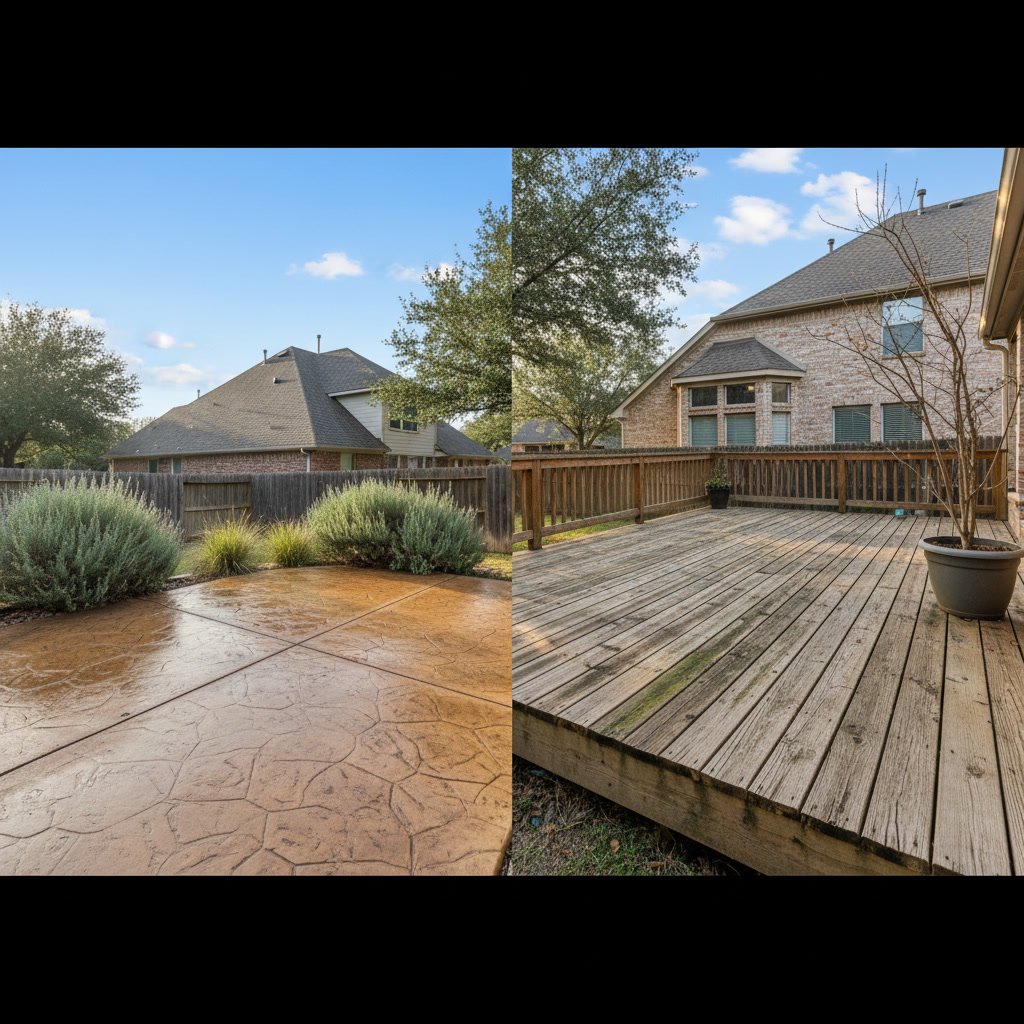
Wood decks demand consistent attention. You’ll need to clean, sand, and reseal or stain pressure-treated lumber every one to three years. Professional refinishing costs $2 to $4 per square foot, or plan on spending a weekend and $150 to $300 in materials for DIY work.
Composite decking eliminates staining but still needs annual cleaning and periodic board replacement if damaged. Budget $500 to $800 every five years for repairs on a typical deck.
Termites and wood rot are real concerns in humid North Texas summers. Annual inspections and prompt repairs prevent minor issues from becoming structural problems.
Durability in Plano’s Climate
Texas weather tests outdoor structures year-round. Summer temperatures regularly hit 95 to 105 degrees, while winter freezes are uncommon but damaging when they occur.
Concrete handles heat exceptionally well. It won’t warp, splinter, or fade in direct sunlight. The main vulnerability is our expansive clay soil, which shifts during wet and dry periods. Proper base preparation with compacted gravel minimizes this risk.
Wood decks face tougher challenges. Intense UV exposure fades and weakens wood fibers. Temperature swings cause boards to expand and contract, leading to warping, cupping, and nail pops. Dark composite materials absorb heat and can become uncomfortably hot to walk on barefoot in July and August.
Expected lifespan matters for long-term planning. A well-built concrete patio lasts 30 to 50 years with minimal maintenance. Pressure-treated wood decks typically last 15 to 20 years before needing major repairs or replacement. Composite extends that to 25 to 30 years.
Design Flexibility and Aesthetics
Your outdoor space should match your home’s style and your family’s needs. Both options offer design versatility, just in different ways.
Concrete Design Options
Modern concrete goes far beyond gray slabs. Stamped patterns mimic slate, flagstone, brick, or wood planks. Integral color and stains create earth tones, terra cotta, or even blue-gray palettes. Exposed aggregate adds texture and visual interest.
Concrete works for any shape. Curved edges, irregular borders, and integrated planters are straightforward. You can also combine it with pavers or natural stone for a custom look.
The main limitation is elevation. Concrete patios work best at or near ground level. Raising them requires significant foundation work and retaining walls.
Wood Deck Design Options
Decks excel at multi-level designs and elevated spaces. If your yard slopes or you want a second-story outdoor room, decks are often the only practical choice.
Wood offers natural warmth and a traditional look that suits many architectural styles. Composite materials expand the color palette to grays, browns, and even exotic hardwood tones without the exotic price tag or environmental concerns.
Built-in benches, planters, and privacy screens integrate easily into deck construction. Pergolas and patio covers attach more simply to deck framing than to concrete slabs.
Comfort and Usability
How you’ll actually use the space matters more than how it looks in photos.
Concrete stays cooler underfoot than wood or composite in direct sun, though it still gets warm. Light-colored finishes reflect heat better than dark stains. The hard surface is ideal for outdoor furniture, grills, and fire pits. You can drag chairs around without worrying about snags or splinters.
Wood decks feel warmer and softer underfoot, which many people prefer. However, splinters are a real concern with older or poorly maintained wood. Composite solves the splinter problem but can get slippery when wet and uncomfortably hot in peak summer.
Drainage differs between the two. Decks shed water through gaps between boards, drying quickly after rain. The space underneath stays dry for storage. Concrete requires proper sloping and drainage design to prevent pooling, and the area beneath a raised patio is essentially dead space unless you add retaining walls and access.
Key Takeaway: If you entertain frequently or have young children who play barefoot outside, concrete’s smooth, splinter-free surface and quick-drying nature offer practical advantages in daily use.
Return on Investment and Resale Value
Both improvements add value to your home, but the numbers vary based on quality and market conditions in Plano real estate.
Wood decks typically return 60 to 75 percent of their cost at resale according to national remodeling surveys. A $10,000 deck adds roughly $6,000 to $7,500 in home value. Buyers appreciate outdoor living space, especially in move-in-ready condition.
Concrete patios return slightly less in percentage terms, around 50 to 65 percent, but the lower initial investment often means similar or better absolute dollar returns. A $4,000 patio that adds $2,500 in value delivers comparable ROI to a more expensive deck.
Condition at sale time matters enormously. A weathered, faded deck with loose boards hurts curb appeal. A well-maintained concrete patio still looks good after 15 years with minimal work. If you’re planning to sell within five to seven years, concrete’s lower maintenance needs may preserve more value.
Local preferences also play a role. Plano buyers expect outdoor living spaces. Homes with quality patios or decks sell faster than those without. The specific choice between concrete and wood matters less than having a functional, attractive outdoor area.
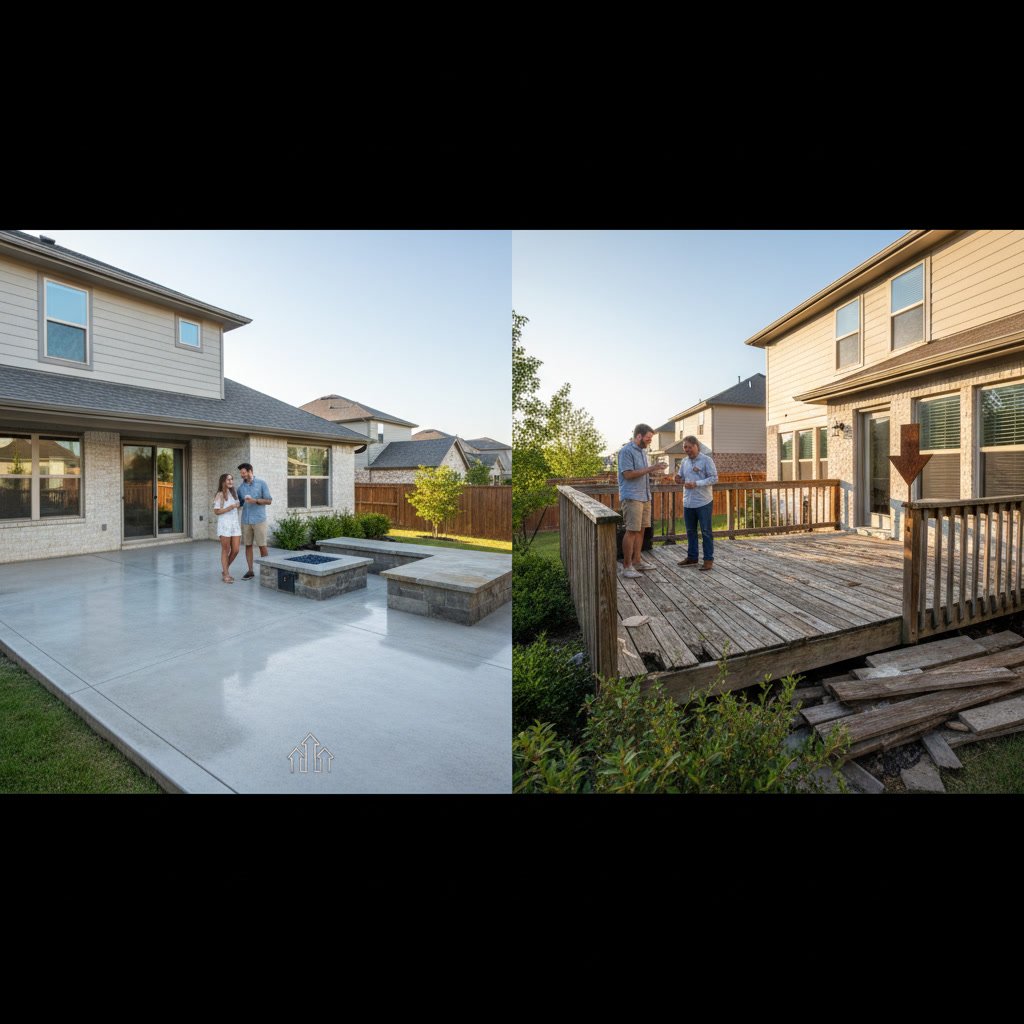
Combining Both for Maximum Benefit
The concrete patio vs deck question assumes you must choose one. Many Plano homeowners get better results by combining both.
A common approach uses a concrete patio as the main entertainment area near the house, with a smaller elevated deck extending from a second-story door or overlooking a pool. This gives you a large, low-maintenance space for grills and dining furniture plus a private retreat with better views.
Another option creates a concrete base with a pergola or covered structure above. You get the durability of concrete with the shade and architectural interest of wood framing overhead. This combination costs less than a full covered deck but delivers similar functionality.
Ground-level decks with concrete skirts or pathways connecting to the yard work well too. The deck provides the natural wood aesthetic near the house while concrete handles high-traffic walkways and utility areas.
Making the Right Choice for Your Home
No universal answer fits every situation. Your decision depends on specific factors unique to your property and priorities.
Choose concrete if you want the lowest long-term cost, minimal maintenance, ground-level installation, and maximum durability in Texas heat. It’s the smart pick for large entertainment areas, pool surrounds, and situations where you need a solid base for heavy outdoor kitchens or fire features.
Choose a deck if you need elevation for sloped lots or second-story access, prefer the look and feel of natural wood, want built-in seating or planters, or plan to add a roof structure. Decks also make sense for smaller spaces where the maintenance commitment stays manageable.
Consider your timeline too. If you’re staying in your home for 15-plus years, concrete’s durability and low upkeep save money and hassle. If you might move within five to 10 years, either option works as long as you maintain it properly.
Your existing landscape matters as well. Homes with established trees and gardens often integrate decks more easily since you can work around roots without extensive excavation. Open yards with level grades are ideal for concrete.
Frequently Asked Questions
Can you build a deck directly on a concrete patio?
Yes, you can install deck framing over an existing concrete slab using sleeper joists or adjustable pedestals. This approach works well if your concrete is in good condition but you want the aesthetic of wood or composite decking. It adds 4 to 6 inches of height, so check door clearances first.
How long does it take to install a concrete patio versus a wood deck?
A basic concrete patio takes two to four days including excavation, forming, pouring, and curing time. You can walk on it after 24 to 48 hours, but wait seven days before placing heavy furniture. A wood deck typically takes three to seven days depending on size and complexity, with no cure time required.
Do concrete patios crack in Texas clay soil?
Cracks can develop due to soil movement, but proper installation minimizes this risk. A 4 to 6-inch compacted gravel base, control joints every 8 to 10 feet, and appropriate concrete thickness (4 inches minimum) help prevent major cracking. Minor hairline cracks are cosmetic and don’t affect structural integrity.
Which option is better for resale value in Plano?
Both add value, but condition matters more than material type. A well-maintained concrete patio or quality deck in good repair appeals to buyers. Neglected decks with peeling stain or cracked concrete hurt resale value. Choose based on which you’ll realistically maintain, not just potential ROI.
Can you add a roof or cover to a concrete patio?
Yes, you can add pergolas, shade sails, or full roof structures to concrete patios. Freestanding designs sit on their own footings. Attached covers require proper ledger board installation on your home’s exterior. The concrete slab itself typically needs additional footings for support posts unless specifically designed for a covered structure during initial installation.
Professional Installation Makes the Difference
Whether you choose concrete or wood, professional installation ensures your investment performs as expected. Poor base preparation, incorrect drainage slope, or substandard materials lead to premature failure regardless of which option you select.
The concrete patio vs deck decision ultimately comes down to your specific situation. Concrete offers unbeatable durability and low maintenance at a lower upfront cost. Decks provide elevation options, natural aesthetics, and integrated design features. Both serve Plano homeowners well when properly built and maintained.
Moore Construction Co. has built both concrete patios and wood decks throughout Plano and the surrounding areas for years. Our team can assess your yard, discuss your goals, and recommend the best solution for your home and budget. We handle everything from design through final cleanup, treating your project with the same care we’d give our own homes.
Ready to add outdoor living space to your Plano home? Contact Moore Construction Co. at +19728205950 to schedule a free consultation and get a detailed estimate for your concrete patio or deck project.