


The real difference boils down to this: screws give you incredible holding power and make future repairs a breeze, while nails get the job done faster and for less money upfront. When you're putting up a fence, especially in the Dallas-Fort Worth area where our weather can be brutal, you have to decide what matters more: long-term strength or initial speed and cost.
Breaking Down the Great Fence Debate
Choosing between screws or nails for your fence is more than just a minor detail—it's a decision that will impact how long your fence lasts, how much maintenance it needs, and the total cost. It's easy to see the appeal of a pneumatic nailer; it can fasten pickets with lightning speed, which definitely saves on labor costs. But that speed comes with a trade-off.
Even the best ring shank nails hold boards in place with friction. Over time, as wood expands and contracts with the Texas humidity and scorching heat, those nails can start to work themselves loose. This leads to the classic "nail pop" problem, leaving you with rattling pickets and a weakened fence.
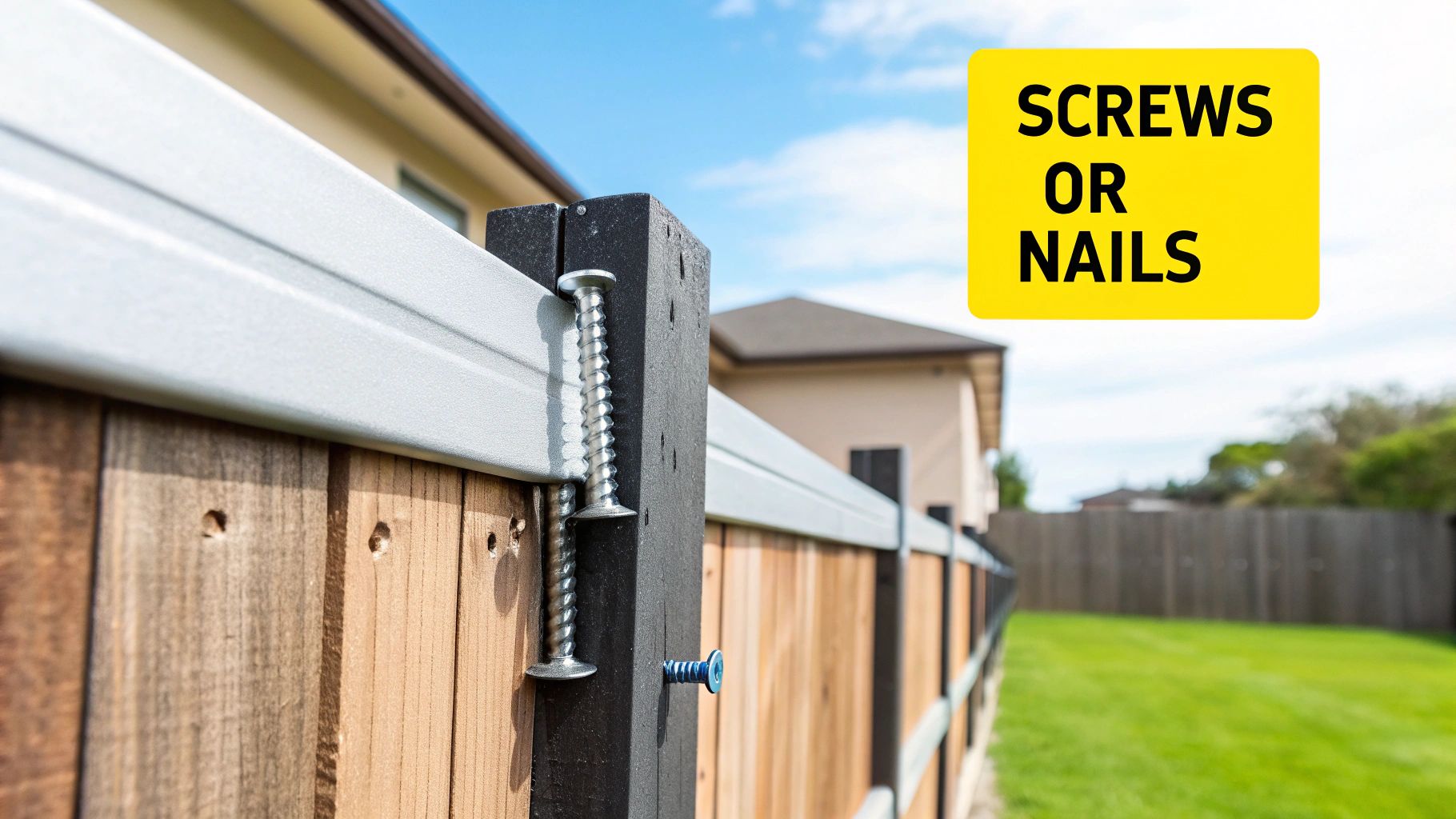
Screws, on the other hand, form a mechanical bond by cutting threads directly into the wood fibers. This gives them far greater withdrawal strength, locking pickets down tight and preventing them from warping or twisting. While screwing each picket is a more deliberate and costly process, you'll see the payoff in stability and much simpler repairs down the road.
Think about it: if a single board warps, you can just back out a few screws to replace it. Trying to do that with nails usually involves a pry bar, which often damages both the picket and the rail it's attached to.
At a Glance: Screws Vs. Nails for Fencing
To help you frame the decision, let’s look at how each fastener stacks up across the most important factors. This table gives you a clear snapshot of their core strengths and weaknesses.
| Feature | Screws | Nails |
|---|---|---|
| Holding Power | Excellent (Mechanical grip) | Good (Friction-based) |
| Installation Speed | Slower, more deliberate | Very fast with pneumatic tools |
| Upfront Cost | Higher (per fastener & labor) | Lower (per fastener & labor) |
| Ease of Repair | Easy to remove and replace | Difficult, can cause damage |
| Longevity | Superior, resists loosening | Prone to loosening over time |
| Best For | Durability, gates, high-wind areas | Budget, speed, large-scale projects |
Ultimately, knowing these nuances is what leads to a better fence. To truly settle the debate for your project, it helps to understand the huge variety of fasteners available, including all types of screws designed specifically for outdoor wood projects.
If you want expert guidance to make the right call, learn more about our professional fence installation and repair services in Dallas.
Comparing Installation Speed and Project Cost
When you’re weighing screws against nails for a new fence, two of the most practical things to think about are how fast the job will get done and how much it’s going to cost. This is where nails really pull ahead, especially when a professional crew is using pneumatic nail guns. The sheer speed they can achieve is something driving screws one by one just can't match.
That efficiency isn't just about finishing sooner—it directly impacts your wallet. A faster project means fewer billable labor hours, making nails the obvious choice for big fencing projects where the budget is a top priority. Using screws is a much more careful and deliberate process, and that extra time adds up.
Labor and Time: A Financial Breakdown
The difference in installation time isn't just a few minutes here and there. For professional fence builders, the conversation often comes back to efficiency, and that's a debate nails win hands-down on most large projects. An experienced team with pneumatic nailers can put up hundreds of feet of fencing in a single day, a pace that slows to a crawl with screws.
Let’s put some numbers on it. For a standard 100-foot section of a 6-foot privacy fence, installation with nails might take 4-5 hours. Switching to screws easily pushes that same job to 6-7 hours. At an average labor rate of $65 per hour, that two-hour difference means the screw installation costs over $100 more for every 100 feet of fence. You can dig deeper into this cost-benefit analysis in this detailed fence fastener comparison.
This financial reality is exactly why most pros default to high-quality ring shank nails. The labor savings can be massive, especially on larger properties that need hundreds of feet of fencing. While screws give you superior holding power, you're paying a premium for it in both time and money upfront.
Comparing Material Costs
Beyond the labor, the cost of the fasteners themselves makes a difference. A few cents per piece might not sound like much, but when a typical 100-foot fence needs over a thousand fasteners, it adds up fast.
Key Insight: High-quality, corrosion-resistant deck screws are almost always more expensive than their ring shank nail counterparts. That higher material cost, piled on top of the extra labor, makes screws a much bigger initial investment.
Think about these cost factors:
- Nails: A bulk box of several thousand hot-dip galvanized ring shank nails is pretty easy on the budget.
- Screws: Exterior-grade screws with polymer coatings or stainless steel construction cost more per unit because of their advanced engineering and protective finishes.
Ultimately, choosing screws is an investment in the fence's long-term stability and makes future repairs a lot easier. But if your main priorities are keeping the initial project cost down and getting the job done quickly, the one-two punch of lower material costs and faster installation makes nails a very compelling and practical choice.
Analyzing Holding Power in Texas Weather
When you’re building a fence in the Dallas-Fort Worth area, the choice between screws and nails really comes down to holding power. Our climate is tough, swinging from humid heat to sudden cold snaps, and your fence fasteners have to be up to the task. It's a classic battle between two different forces: withdrawal strength (how well a fastener resists being pulled straight out) and shear strength (how well it resists sideways pressure).
Getting this right is the difference between a fence that stands tall for a decade and one that starts looking tired after a few seasons.
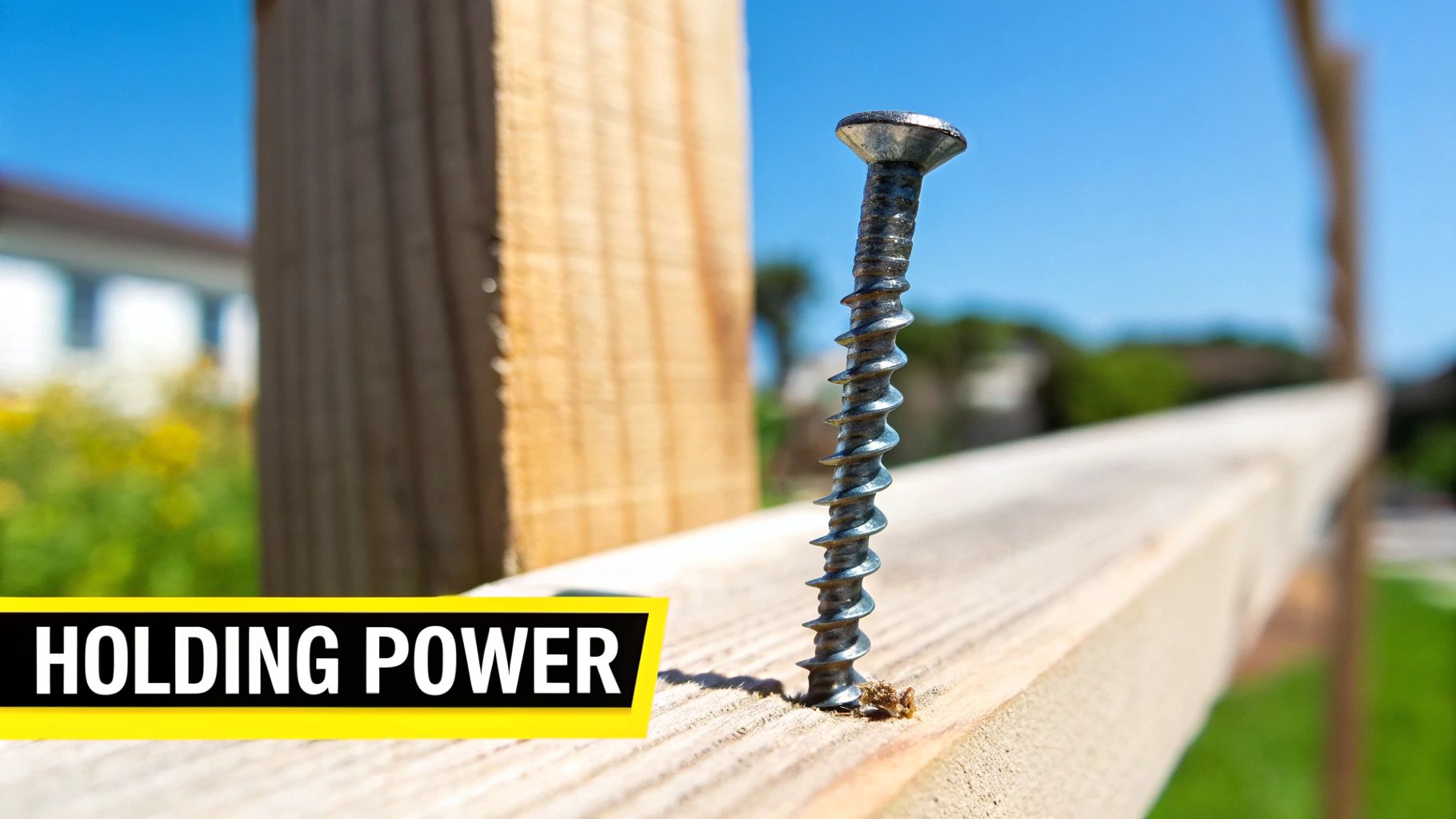
This is where screws really shine. Their threads bite deep into the wood fibers, creating a mechanical lock that’s incredibly resistant to the expansion and contraction that wood goes through here in Texas. They just don't let go.
Nails, even the good ring shank ones, mostly rely on friction. Those rings add a lot of grip compared to a smooth nail, but it’s not the same as a screw’s threaded lock. Over time, as the wood swells and shrinks with the humidity, the wood fibers can loosen their grip, leading to those familiar wobbly pickets.
The Trade-Off Between Grip and Flex
Now, while screws win on pull-out resistance, nails have a slight advantage in shear strength. The thicker, unthreaded shank of a nail can bend a bit before it breaks. This gives it more flexibility to absorb a sudden sideways impact, like a heavy branch falling during a storm or a stray baseball from the kids.
Screws, being harder and more brittle, can sometimes snap under that kind of sharp, direct force.
Key Takeaway: Screws lock pickets down tight to stop warping from our humidity, making them the champ for long-term stability. Nails offer a bit more flex against sudden impacts but can lose their grip over the years as the weather does its work.
For preventing the most common fence problems we see around here—pickets warping, cupping, or pulling away from the rails—screws are the clear winner. That unmatched grip keeps everything tight and secure, season after season.
Fastener Performance In DFW Climate Conditions
To really see the difference, it helps to put screws and high-quality ring shank nails side-by-side. Here’s a quick breakdown of how they stack up against the challenges our North Texas weather throws at them.
| Performance Metric | Screws | Nails (Ring Shank) |
|---|---|---|
| Withdrawal Strength | Excellent. Threads lock into wood, resisting pull-out from swelling/shrinking. | Good. Rings add friction, but grip can loosen over many weather cycles. |
| Shear Strength | Good. Hardened steel is strong but can be brittle under sudden, sharp impact. | Excellent. Softer metal allows for more flex and bend before breaking. |
| Warping Prevention | Excellent. Provides a tight, rigid connection that keeps boards flat. | Fair. Loosening grip over time can allow pickets to cup and twist. |
| Long-Term Durability | Excellent. Maintains a secure hold through years of humidity and temperature changes. | Good. Performance degrades as wood fibers around the nail shaft loosen. |
This table makes it pretty clear: for a fence built to last in DFW, the superior grip and long-term stability of screws are hard to beat.
Long-Term Performance in Challenging Climates
In a climate like ours, long-term holding power is what truly separates the two. A study done in Georgia—which has a similarly humid environment—found that wood screws kept 85-90% of their original grip after ten years. That's impressive.
In that same study, smooth-shank nails dropped to just 50-60% of their initial holding power as the wood fibers gave way. You can read more about these findings on long-term fastener performance on PrecisionFenceWorks.com. This shows just how critical those threads are for withstanding years of humidity cycles and Texas storms.
So, if your priority is a fence that stays rigid, quiet, and structurally sound with minimal fuss, investing in screws is the way to go. The mechanical bond they create is simply better suited to handle everything our Texas weather can throw at it.
Matching Fasteners to Your Fence Materials
The kind of fence you build isn't just about looks; it directly tells you which fasteners you need for a solid, long-lasting job. If you use the wrong screw or nail with a particular wood, you’re setting yourself up for premature corrosion, ugly stains, or even split pickets. Getting this match right from the very beginning is absolutely critical.
Different woods have their own unique quirks and react differently to metal. Making the right choice here protects your investment and keeps your fence looking great for years.
Fasteners for Pressure-Treated Pine
Pressure-treated pine is a go-to, budget-friendly choice here in Texas, but there’s a catch. The very chemicals that preserve the wood are incredibly corrosive to standard metal. Using the wrong fastener is a mistake you can't afford to make.
Within just a few months, untreated screws or nails will start to rust. You'll see those tell-tale black, streaky stains running down your pickets, and worse, the connection itself will be compromised.
For this material, you absolutely must use fasteners designed to handle this chemical reaction:
- Hot-Dip Galvanized: These aren't just coated; they're dipped in a thick layer of zinc that creates a tough, protective barrier against corrosion.
- Polymer-Coated: These screws have a specialized coating that adds another layer of defense, which is perfect for the high moisture and humidity we deal with.
Expert Tip: Always, always check the fastener's box to make sure it’s specifically rated for use with modern ACQ (Alkaline Copper Quaternary) or other pressure-treated lumber. This simple check will save you a massive headache down the road.
Choosing Screws or Nails for Cedar Fences
Everyone loves cedar for its natural beauty and rot resistance, but it's a softer wood that can split more easily than pine. This just means it needs a bit more finesse during installation. If you're weighing your options, check out our guide on the best fence material to enhance your property.
When you're working with cedar pickets, keep these points in mind:
- Screws: The best way to go is to pre-drill pilot holes, especially near the ends of the boards. It’s an extra step, but it relieves pressure and lets the screw seat cleanly without splitting those delicate wood fibers.
- Nails: If you’re set on using nails, grab a slender-shank or "trim" nail. Their thinner profile pushes less wood out of the way, dramatically cutting down the risk of splitting while still giving you a good hold.
On top of that, cedar contains natural tannins that react with some metals, causing dark, unsightly stains. For a truly pristine look, stainless steel screws are the premium choice. They are completely non-reactive and will keep the wood looking clean and beautiful.
Attaching Wood to Steel Posts
We see a lot of hybrid fences that combine the strength of steel posts with the classic look of wooden rails and pickets. When you’re building one of these, screws are the only professional choice, hands down.
A screw’s ability to be driven with high torque creates an incredible clamping force, pulling the wood rail tight against the steel post bracket. This forms a rigid, secure connection that nails just can't match, making sure the entire fence frame stays strong and stable for its whole life.
How Fasteners Impact Future Repairs and Maintenance
The choice you make between screws and nails isn't just about the initial build; it’s a decision that will echo for years down the road, every time you need to do a repair. While both will give you a solid fence on day one, how they perform over time really separates them when it comes to ease of maintenance, cost, and overall frustration.
A fence lives outside, taking a beating from the sun and rain. Eventually, something is going to need attention. A warped picket, a cracked board—it happens. This is where you’ll really see the difference between a screw-built fence and a nail-built one.
The Simplicity of Screw-Based Repairs
When your fence is put together with screws, swapping out a bad board is refreshingly simple. You just grab a drill, back out the few screws holding the damaged picket, and pop in a new one. The whole job can be done in just a few minutes.
What’s great about this method is how clean it is. It protects the rest of your fence from any collateral damage.
- No extra damage: The structural rail behind the picket stays perfectly intact.
- Clean removal: You’re not prying, splitting, or cracking wood just to get one board off.
- Quick and easy: A simple fix stays simple, needing nothing more than a drill.
Screws turn fence maintenance into a surgical procedure. You can remove and replace parts with precision. Nails, on the other hand, often turn a small fix into a messy demolition job that creates even more problems.
The Challenge of Nail-Based Repairs
Trying to repair a nailed fence is a whole different ballgame. To get a single picket off, your only real option is to jam a pry bar behind it and force it off the rail. It’s a brute-force approach that almost never ends cleanly. More often than not, you’ll damage the picket you’re removing and gouge the rail it was attached to.
On top of that, nails are famous for "nail pops." As the wood fence expands and contracts with changes in humidity and temperature, the smooth shank of the nail can slowly work its way out. It looks sloppy and means you have to walk your fence line every so often, hammering them all back in.
Screws, with their deep threads biting into the wood, just don't have this problem. If a screw ever feels a bit loose, a quick zip with the drill tightens it right back up, keeping your wood fence panels secure for the long haul.
Making the Final Decision for Your Project
So, which is it: screws or nails? The truth is, it all comes down to what you value most for your fence project. There's no single "correct" answer, but there's definitely a best fastener based on your goals for cost, speed, and how long you want the fence to last with minimal fuss.
If you're tackling a massive perimeter fence and the main goals are getting it done fast and keeping the initial cost down, high-quality ring shank nails are a fantastic choice. Their lower price point and the speed you get with a pneumatic nailer make them the go-to for many professional builders. You'll get a solid, functional fence built efficiently.
But, if your top priority is sheer strength and avoiding future maintenance headaches, then spending a little extra on the right screws is the smarter long-term move.
Prioritizing Strength and Longevity
Think about the parts of your fence that take the most abuse. Gates, for instance, are constantly moving and under stress. For these critical components, the incredible holding power of screws is non-negotiable. Screws are also the clear winner for any fence sections that get hammered by high winds or for homeowners who simply want the toughest, lowest-maintenance fence possible.
And let's not forget about repairs. The ability to easily back out a few screws and replace a single warped picket without tearing apart the rail is a huge advantage that you'll appreciate years down the road.
This chart really simplifies the difference when it comes to fixing things later.
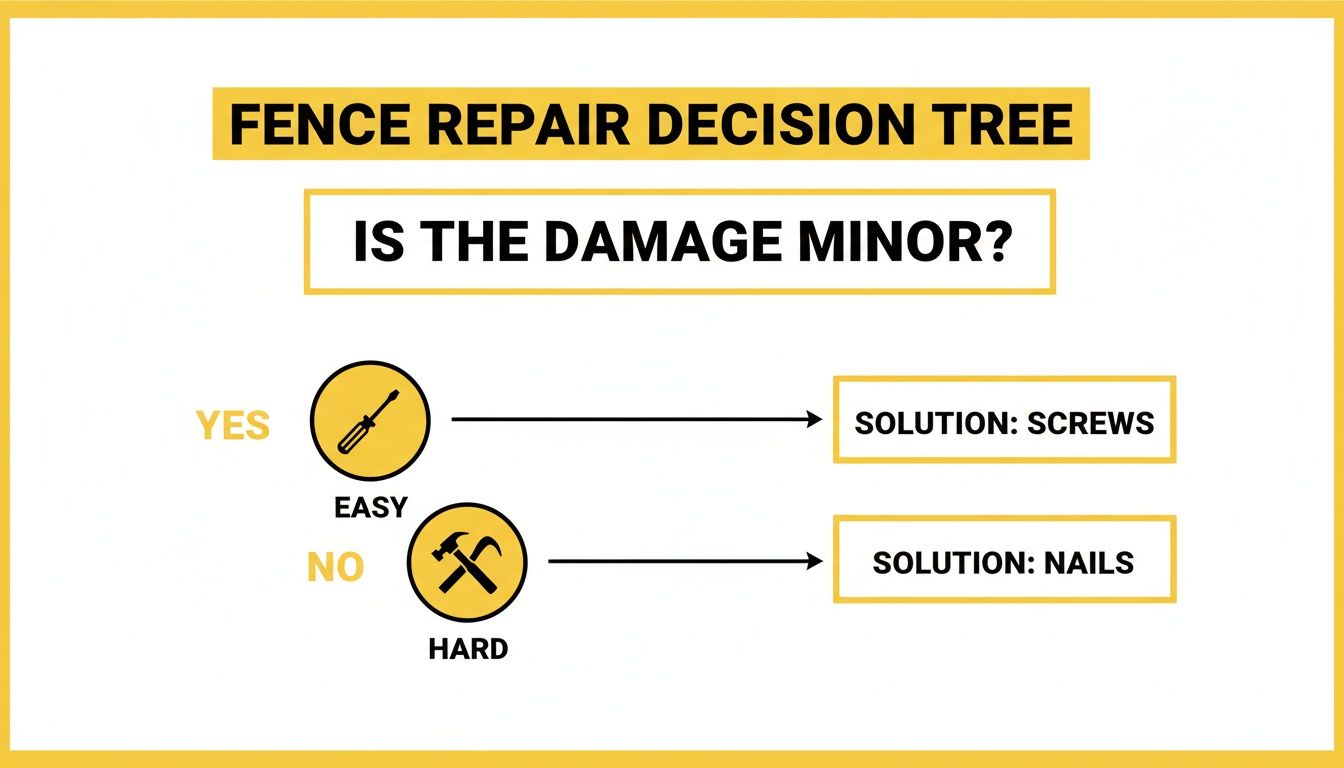
As you can see, screws make for a much cleaner and simpler repair job. Trying to pry out old, set nails often requires more force and can damage the wood you're trying to save.
Our Pro Recommendation: For most DFW homeowners, we find a hybrid approach works wonders. Use cost-effective ring shank nails for the bulk of the pickets to keep the budget in check, but switch to high-quality structural screws for building the gate and attaching the main rails to the posts. This strategy gives you the best of both worlds—speed and savings where it makes sense, and rock-solid strength where it counts.
As you get your fence plans together, don't forget that a great fence starts from the ground up. A strong foundation is everything, so it's worth learning how to dig a fence post hole like a pro.
Got a Few More Questions About Fence Fasteners?
After weighing all the options, you might still have a couple of specific things you're wondering about. Let's clear up some of the most common questions we hear from homeowners trying to pick the right fastener for their fence.
Do I Really Need Special Screws for Pressure-Treated Wood?
Yes, this is non-negotiable. Modern pressure-treated lumber contains chemicals that will eat right through standard screws, causing them to rust and fail surprisingly quickly. It’s a recipe for disaster.
You have to use fasteners specifically rated for this type of wood. Look for hot-dip galvanized, ceramic-coated, or stainless steel screws. Taking this extra step is crucial—it stops the rust, prevents those ugly black streaks from running down your fence, and keeps your fasteners strong for the long haul.
Are Screws Going to Split My Wooden Fence Pickets?
It's a valid concern. Screws are thicker than nails, so they absolutely can split a board, especially if you're working close to the end. The best way to prevent this is to pre-drill a small pilot hole first. This is especially important for hardwoods.
Another great option is to use screws with a self-drilling tip. These are designed to clear away wood as they go in, which dramatically cuts down the risk of splitting.
Pro Tip: If you’re driving a lot of screws, an impact driver is your best friend. It delivers powerful bursts of torque that drive screws in with way less effort and a much lower chance of stripping the head. It's a game-changer compared to a standard drill and saves a ton of strain on your wrist.
What's Better for Attaching the Rails to the Posts?
When it comes to connecting the main structural rails to your fence posts, screws are almost always the right call. Nothing beats their withdrawal strength. This creates a rock-solid frame that won't sag, pull apart, or weaken over the years.
In fact, it’s common practice for pros to use nails on the pickets (for speed) but switch to heavy-duty structural screws or lag bolts for these critical rail-to-post connections. You just can’t compromise on the foundation of your fence.
Building a fence that stands the test of time is about more than just picking screws or nails; it’s about expert craftsmanship from the first post hole to the last picket. If you’d rather have a durable, beautiful fence without all the guesswork and hard labor, trust the professionals at Moore Construction Co.
We’ll get the job done right, ensuring your fence is built to last. Schedule your free estimate at https://mooreconstructionco.com today.
Drafted with the Outrank app


